What to expect
Look at how many fruits and which ingredients enter the final glass. The whole recipe matters; “green” and “fresh” do not replace that examination. For a snack, also consider whole foods and combinations you enjoy. Do not use a juice programme to replace meals for an extended period without support.
Keep a recipe question separate from a product claim. The evidence method explains how to record the exact claim, product and source; the patches review is another example of checking whether evidence matches the product being discussed.
Write the recipe before the slogan
List fruits or vegetables, other ingredients and final volume for a homemade drink. You can also make a salad with the same whole fruits if that format suits you. These are two recipes to compare for taste and their place in a meal; “detox” adds evidence to neither.
EXAMPLE / HOW TO USE IT
An example to adapt
Prepare a small amount for flavour, or choose whole fruit with another snack component. The objective is variety, without turning a glass into a health solution.

Read the figure text
What to expect: Look at how many fruits and which ingredients enter the final glass. · Write the recipe before the slogan: List fruits or vegetables, other ingredients and final volume for a homemade drink.
Keep this checklist
- List the ingredients.
- Keep your eating varied.
- Place this choice within your overall meals.
- Reassess according to your circumstances and preferences.
Sources and limitations
- Santé publique France — food and activity guidance (French)
- Assurance Maladie — everyday changes (French)
References consulted for this edition. Studies and documents retain their actual years. Educational examples and documentary procedures, not personal product trials.
Calculate the sugars in your actual glass
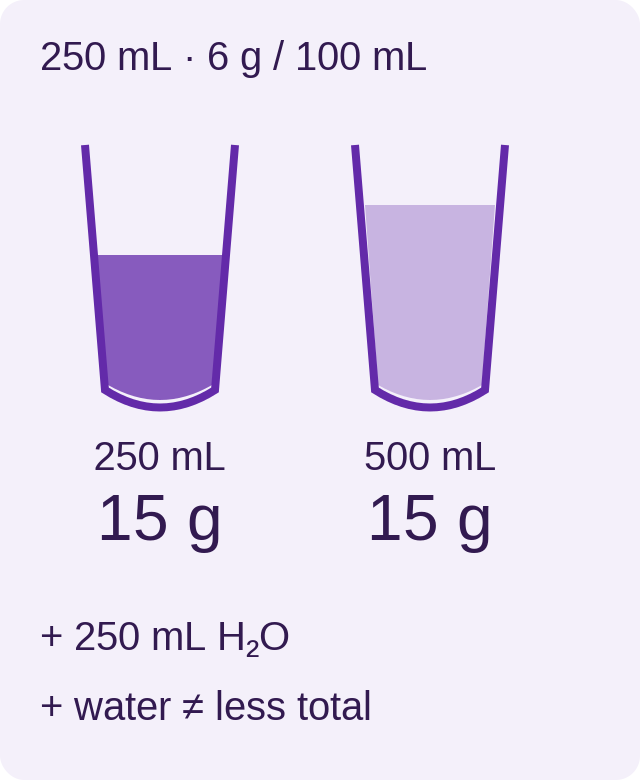
This is a fictional label exercise, not a tested recipe or a recommended portion. Suppose drink A lists 6 g of sugars per 100 mL. Pouring 250 mL gives 6 × 250 ÷ 100 = 15 g of sugars.
- Copy the label’s unit and value: sugars, 6 g per 100 mL. Do not substitute the carbohydrate line.
- Measure the amount actually poured: 250 mL. Multiply the label value by that amount and divide by 100.
- If you add 250 mL of plain water and drink the entire 500 mL mixture, it still contains 15 g. The concentration becomes 3 g per 100 mL. Water changes concentration, not the total already poured.
A 250 mL serving of the evenly mixed diluted drink would contain 7.5 g. That is half of the mixture, not a disappearance of sugar. Record both volume and total before comparing drinks.
Worksheet: drink A; label 6 g/100 mL; original volume 250 mL; water 250 mL; final volume 500 mL; total 15 g; half-mixture 7.5 g. For an unlabelled homemade recipe, these values cannot be assumed: record ingredients and final volume, and do not present an invented nutrition figure.
WHO includes sugars naturally present in fruit juice in its definition of free sugars. The label’s “sugars” line alone does not quantify the free-sugar share of every mixed recipe. This calculation establishes neither a detox effect nor a weight-loss result.