
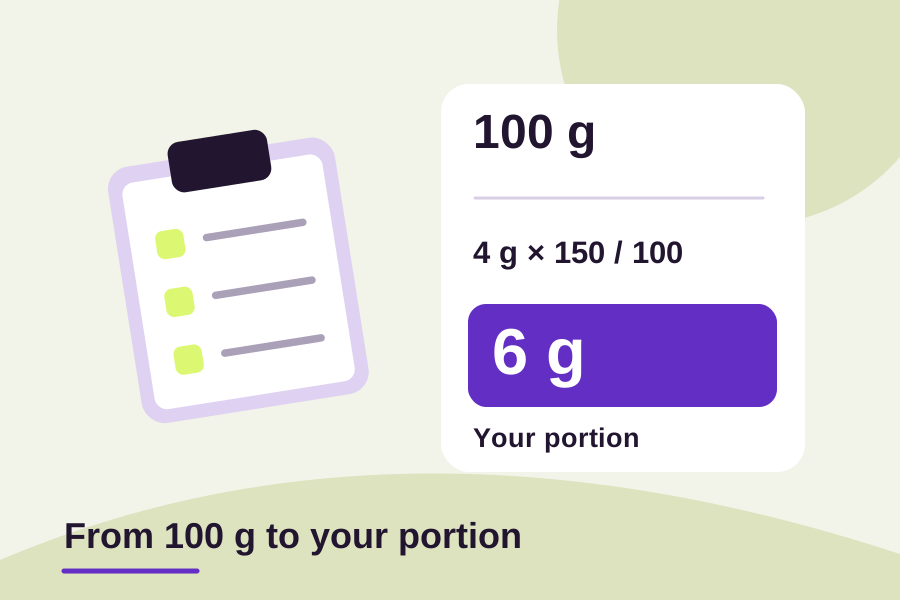
Start with the printed value
Record a nutritional value per 100 g or 100 ml and its unit: grams, kilocalories or another displayed unit. Mass in grams and volume in millilitres are not interchangeable without additional product information. Keep the same basis as the label.
Apply a proportion
For 150 g, multiply the per-100-g value by 150 and divide by 100. If the label gives 4 g of protein per 100 g, 150 g corresponds to 6 g. This is an arithmetic example, not a tested-product analysis. Printed values are rounded; calculation does not increase their precision.
Compare without forgetting the rest
A conversion does not summarise the product: ingredients, taste, price and dietary constraints still matter. Comparing at the same amount can help, but amounts actually eaten may differ. The calculator works locally and requests neither body weight nor health information.
EXAMPLE / HOW TO USE IT
A checkable example
Value = 4; quantity = 150. Calculation: 4 × 150 ÷ 100 = 6. At 0 g the result is 0. Negative values and blank entries are refused. A decimal comma can be used while retaining the original unit.
LOCAL CALCULATION / NO ANSWERS TRANSMITTED
Convert a value into a portion
Example: 4 × 150 ÷ 100 = 6 g.
Arithmetic only. Label rounding remains. Use g with a per-100-g label and ml with a per-100-ml label.
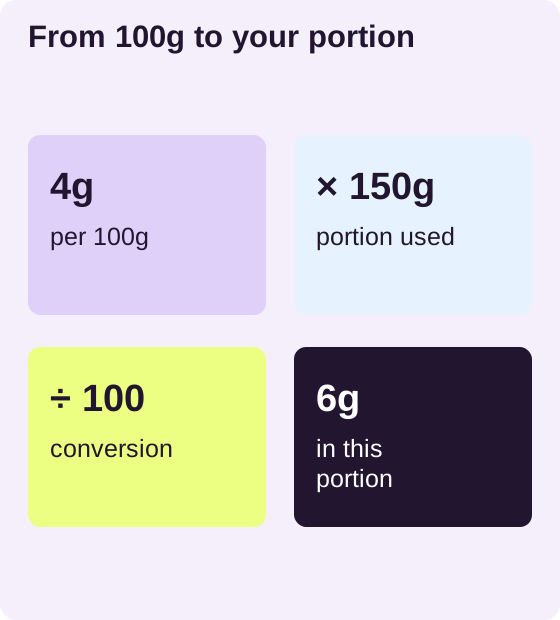
Read the figure text
From 100g to your portion · 4g · per 100g · × 150g · portion used · ÷ 100 · conversion · 6g · in this portion
Keep this checklist
- Record the value per 100 g or 100 ml.
- Choose a quantity on the same basis.
- Multiply, then divide by 100.
- Read the result with the label’s limitations.
Sources and limitations
References consulted for this edition. Studies and documents retain their actual years. Educational examples and documentary procedures, not personal product trials.